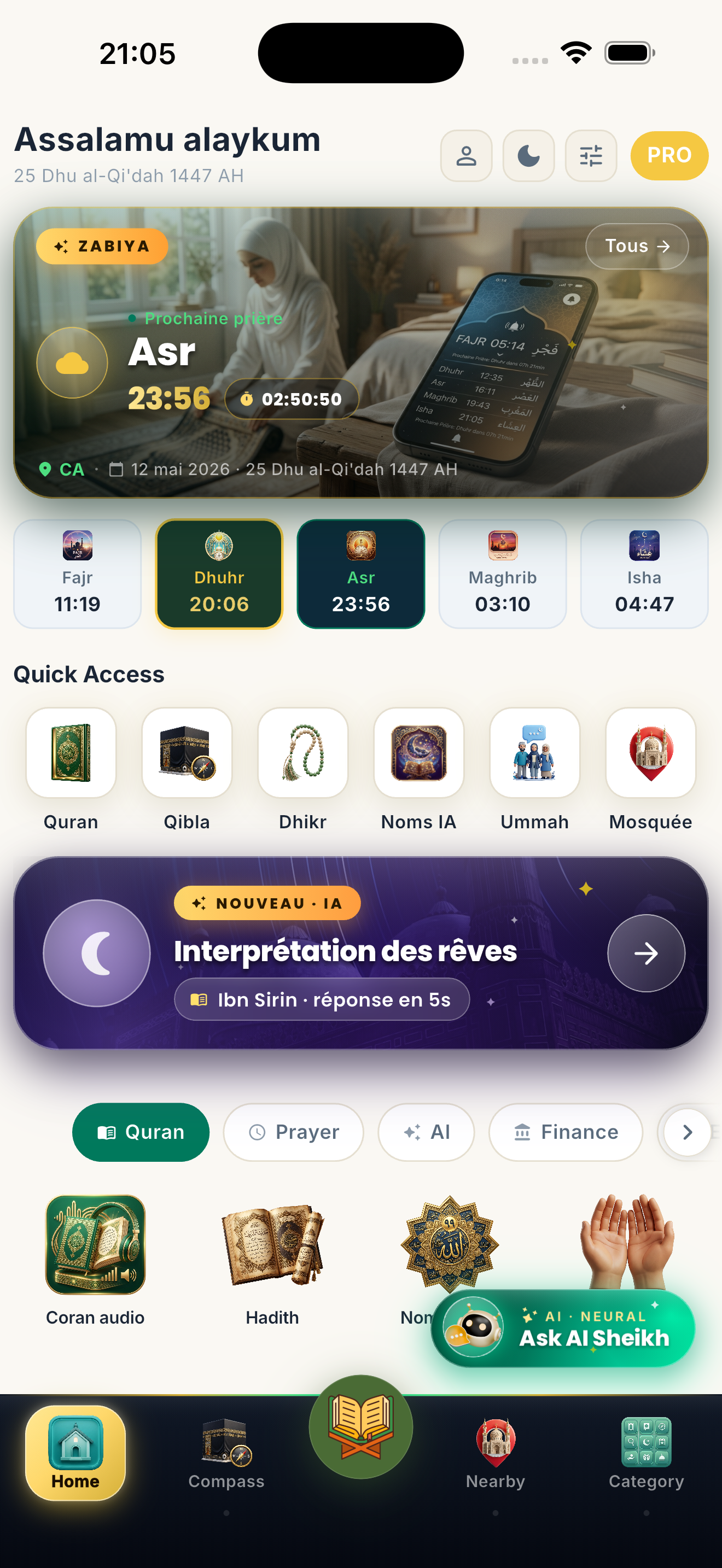
Discover how AR technology transforms Qibla finding with GPS precision, 3D compass and augmented reality for perfect orientation toward Mecca.
AR technology integrated into Qibla applications
Augmented reality (AR) Qibla applications use three sensors in your smartphone: GPS to locate your exact position, the gyroscope to detect device tilt, and the magnetic compass for orientation. When you activate the camera, the application overlays a 3D arrow directly on the real image of your environment, pointing toward the Kaaba with ±2 degree precision. This technology eliminates interpretation errors from traditional compasses, particularly useful in modern buildings where metal structures disrupt magnetic fields. The algorithms calculate the orthodromic angle (the shortest path on the Earth's sphere) between your position and the exact coordinates of the Kaaba (21.4225° N, 39.8262° E). In 2026, more than 80 million Muslims use these applications daily for their five obligatory prayers.
Precise Qibla calibration with augmented reality
To obtain an exact direction, follow this three-step calibration procedure. First, move away from sources of magnetic interference: refrigerators, speakers, electrical cables, metal radiators. Second, perform the "figure 8" movement with your smartphone for 10 seconds to recalibrate the internal compass — the application will display "Calibration complete" or a green indicator. Third, hold the device flat in front of you, parallel to the ground, and slowly pivot until the AR arrow stabilizes. Verify accuracy by comparing with the sun's direction: at solar noon, the Qibla points south in metropolitan France (with a 10-15° deviation depending on your longitude). Premium applications like Muslim Pro AR or Qibla Compass 3D also display angular altitude, useful if you're praying in a high-rise building.
Differences between classic compass and Qibla AR
The traditional magnetic compass presents four major limitations that augmented reality solves. Magnetic declination: the magnetic North Pole shifts 3-25° depending on your geographic position; AR automatically applies this correction via GPS. Local interference: steel structures, high-voltage lines and electronic devices distort the classic compass by 10-40°; AR combines GPS and gyroscope to compensate. Complex angle reading: mentally calculating the Qibla azimuth (for example 119° from Paris) then aligning it with a flat compass requires training; AR displays an instant visual arrow. No spatial reference: a compass alone doesn't show whether you're aiming at a wall, window or room corner; the AR camera overlays the direction on your real environment. In mosques, AR allows verification that the mihrab is correctly oriented — studies have revealed that 12% of mosques in Europe have 5-15° errors due to old construction.
Recommended Qibla AR applications in 2026
Muslim Pro AR Qibla
Downloaded by 15 million users, this application offers an animated 3D arrow with ±1.5° GPS precision. It works offline after the first download of location data. The interface simultaneously displays the distance to Mecca (for example 4,287 km from Lyon) and the time of the next prayer.Qibla Compass 3D
Specialized in augmented reality, it offers a "Kaaba View" mode that displays a 3D reconstruction of the Kaaba in your AR environment, sized according to your real distance. Particularly appreciated by new Muslims for its visual pedagogy.Athan Pro with AR
Integrates prayer times with personalized notifications and Qibla AR. The "Mosque Finder" mode uses the camera to indicate surrounding mosques with their walking distance.Using Qibla AR while traveling and on the move
During your business or tourist trips, Qibla AR becomes indispensable in three situations. In hotels: modern rooms rarely have Qibla indications; activate AR to orient your prayer rug in 30 seconds, even in darkness thanks to the camera's flash mode. In transport: on long-distance trains or planes, the Qibla changes continuously; some AR applications update the direction every 5 minutes via real-time GPS (requires data connection or WiFi). Outdoors: during hikes or picnics, AR works without architectural reference, unlike traditional sun-based methods that require complex time calculations. Practical tip: take a screenshot of the AR direction before entering an area without network (forest, mountain) — the arrow remains visible as a static reference. For group prayers outdoors, one person with AR can trace a line on the ground with a stick or rope to align all worshippers.
Reliability and Islamic validation of AR technology
Contemporary scholars, including the European Council for Fatwa and Research (ECFR), have issued favorable opinions regarding the use of technology to determine the Qibla. The Islamic principle relies on sincere intention and reasonable effort (ijtihad) to orient correctly. Prophet Muhammad ﷺ said:
> "What is between East and West is the Qibla." — Sunan al-Tirmidhi 342
This hadith indicates tolerance for small variations, particularly for those far from Mecca. AR applications achieve ±2° precision while scholars authorize a ±5° margin to validate prayer. However, three precautions remain necessary: regularly check application updates (GPS algorithms improve), cross-check with a second method during initial installation in a new home (physical compass or sun position), and maintain the intention (niyyah) to seek the exact direction even if technology facilitates the process. In established mosques, the mihrab remains the priority reference by community consensus, but AR serves as a verification tool for recent constructions.
Offline operation and battery economy
Modern Qibla AR applications integrate essential economical modes for daily use. The GPS cache mode downloads magnetic correction data for your region (2-5 MB file) during first use with Internet, then operates entirely offline relying on the phone's internal GPS chip which requires no network connection. The simple compass mode disables the AR camera to save 60% battery while maintaining calculation precision — ideal for the five daily prayers without recharging. The smart standby mode automatically turns off the screen after 15 seconds once direction is confirmed, with an audio notification if you deviate more than 10°. To optimize consumption, completely close the application after use rather than leaving it in the background. Recent smartphones (2024-2026) with dedicated AR processors (Apple A17, Snapdragon 8 Gen 3) consume 40% less energy than 2022 models for the same calculations.
Qibla precision according to your geographic position
The direction of Mecca varies considerably depending on your location in France and francophone Europe. Paris and Île-de-France: 119° South-East, the Kaaba is located 4,287 km away; in practice, orient yourself slightly left of South. Marseille and PACA: 109° East-South-East, distance of 3,789 km; almost due East direction with 19° deviation toward South. Brussels: 122° South-East, distance of 4,456 km. Geneva: 115° South-East, distance of 4,012 km. Montreal: 54° North-East, distance of 8,873 km — special case where the Qibla points North-East due to Earth's curvature. AR applications automatically calculate these complex orthodromic angles that flat maps (Mercator projection) represent incorrectly. A common error is drawing a straight line on Google Maps: the true Qibla follows a great circle arc that can differ by 15-30° from this apparent line, especially at high latitudes (Scandinavia, Canada).
Integration of Qibla AR in connected objects
The year 2026 marks the emergence of dedicated devices integrating AR technology for Qibla. Islamic smartwatches (like the Nuun Watch Pro or MyDuaa Smart) display a Qibla arrow on the dial with vibration when you're correctly oriented, synchronized with GPS prayer times. Connected prayer rugs have peripheral LEDs that light up on the Qibla side after Bluetooth activation with your smartphone — useful in darkness or for visually impaired people. AR glasses (Meta Ray-Ban Islamic Edition, pilot project) project a holographic arrow in your field of vision without taking out a phone, thus respecting concentration (khushu) during prayer preparation. These innovations raise modern fiqh questions: can one wear a smartwatch during prayer? ECFR scholars authorize passive devices (without active screen) in silent mode, but recommend removing them if their weight or brightness distracts from prayer. The essential remains intention and spiritual presence, with technology serving as preparatory aid rather than an element integrated into the act of worship itself.